The sound came first.
Not loud… but wrong.
Too smooth for a street like that.
One engine… then another… then a third.
People turned.
Cars like that didn’t belong there — not among cracked sidewalks, dust, and the smell of cheap street food.
Three cars — white, black, white — rolled in slowly and stopped right in front of her small cart.
Shiomara froze.
The ladle hung in mid-air, steam from the rice rising softly against her face — warm, real… familiar.
The engines went silent.
Doors opened.
Three people stepped out — two men and one woman.
They were perfect. Clean. Composed. Untouched by the life around them.
And they weren’t looking at the street.
They were looking at her.
Time slowed.
The noise faded.
Only her heartbeat remained…
and a question she had buried deep inside for years:
What did I do wrong?
They walked closer.
Too close.
One of the men tried to smile — but it trembled.
Another swallowed hard, unable to speak.
The woman placed her hand on her chest, as if trying to hold herself together.
Shiomara opened her mouth.
“Good morning—”
But no words came out.
The woman stepped forward, her eyes locked onto Shiomara’s face.
Searching.
Remembering.
Breaking.
Then, in a voice that trembled after years of silence, she whispered:
“…You fed us.”
Shiomara blinked.
Confused.
The man in the blue suit stepped closer.
“We were the kids… under the bridge.”
Her breath caught.
Rain.
Cold nights.
Three small bodies huddled together.
Hungry eyes.
Triplets.
She used to feed them… even when she barely had enough for herself.
The third man spoke softly:
“You told us… ‘Eat first. The world can wait.’”
Her hands began to shake.
“No…” she whispered.
The woman stepped closer, tears finally falling.
“You saved us.”
Silence fell — heavy, overwhelming.
Then the man in the middle reached into his coat and pulled out an envelope.
Thick. Sealed.
He placed it gently on her cart.
Steam curled around it — like the past meeting the present.
“We looked for you for years,” he said quietly.
“We made a promise… if we ever made it—”
His voice broke.
The woman finished, barely above a whisper:
“—we would come back.”
Shiomara couldn’t move.
Couldn’t breathe.
“Open it,” the man said softly.
Her fingers trembled as she did.
Inside… not money.
A photograph.
Old. Faded.
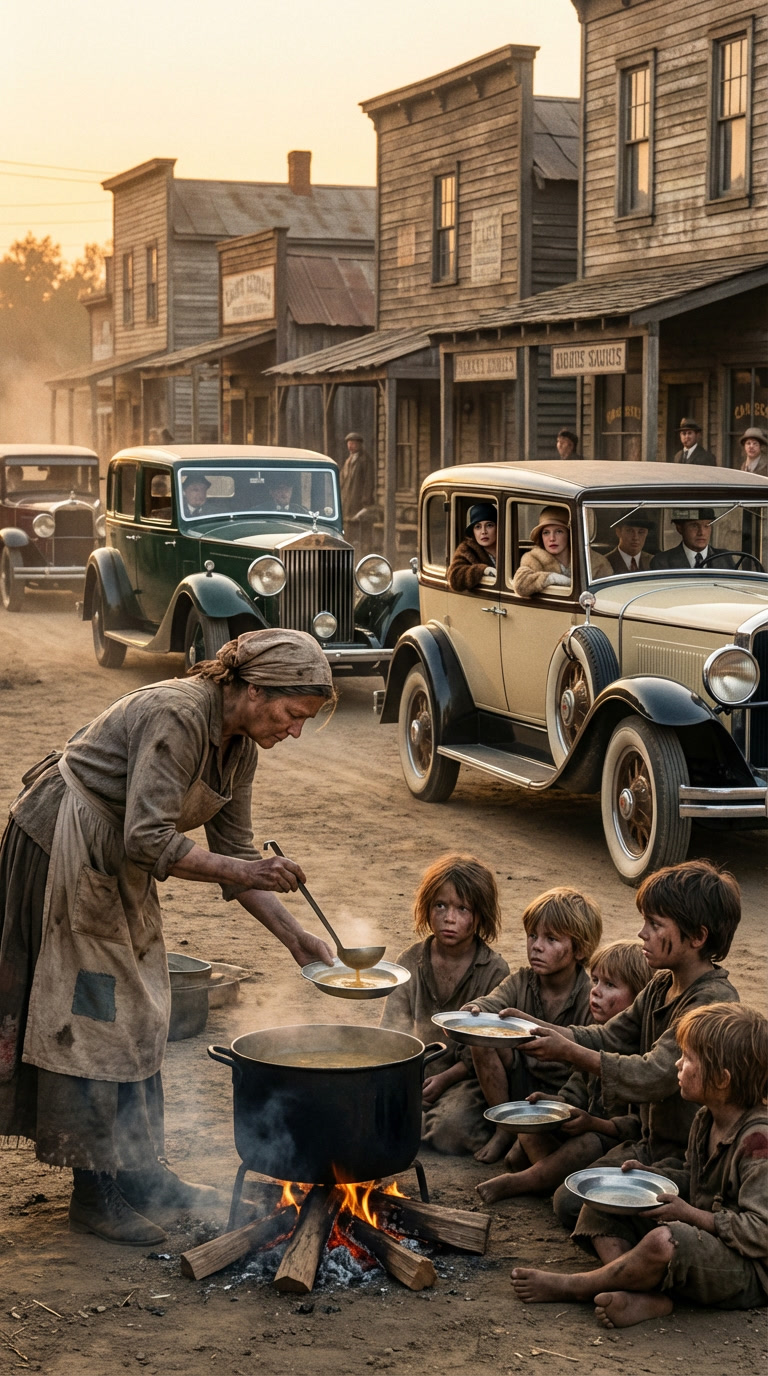
Three small children sitting on the ground, holding plates of food…
And behind them — her.
Smiling. Tired. Kind.
Her vision blurred.
Beneath the photo… a document.
Her name.
Her hands shook harder.
“What… is this…?” she whispered.
The man looked at her — his eyes filled with something deeper than gratitude.
“It’s yours.”
A pause.
Then the words that changed everything:
“You fed us when we had nothing…”
He swallowed, his voice breaking.
“And now… you will never be hungry again.”