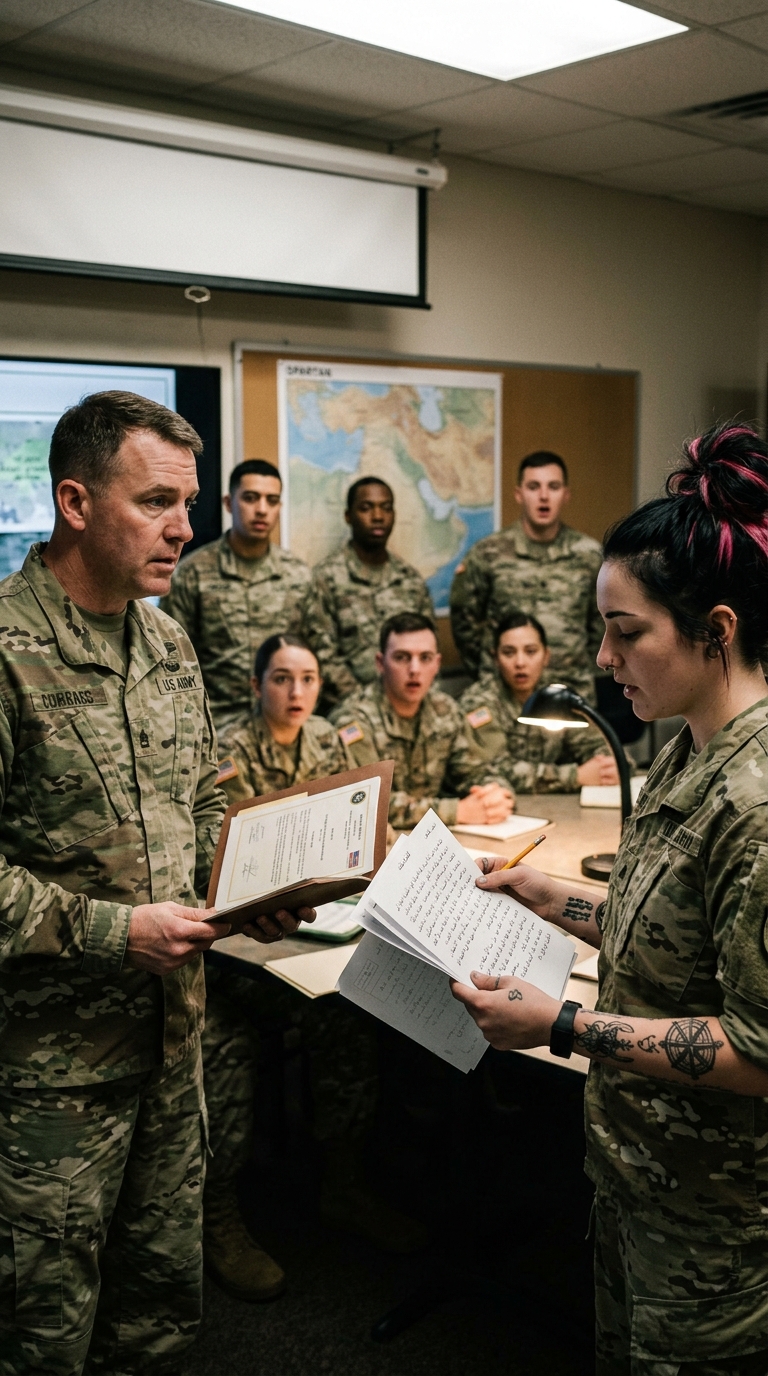
The soldiers burst out laughing when the new recruit claimed she could translate an important document written in Arabic.
They were convinced she was only trying to get attention.
But just minutes later, she did something that completely silenced the entire unit.
When Lulu first arrived at the military unit, almost everyone immediately noticed her.
Compared with the other soldiers, she looked completely different.
Part of her hair was black, while several strands were dyed bright pink. Small metal rings could be seen in her nose and lip, and tattoos covered much of her body.
But it wasn’t only her appearance that made people curious.
Lulu barely spoke to anyone and seemed unusually distant.
During lunch, she always sat alone.
After training, she was usually the first person to return to the barracks.
And whenever someone tried to start a conversation with her, she rarely answered.
Within only a few days, the other soldiers were already whispering about her.
“Let’s see how long she lasts here.”
“She belongs in a psychiatric hospital.”
“Maybe she thought she was joining a rock festival instead of the army.”
Some soldiers deliberately walked past her and joked about whether she had been allowed to bring pink hair dye into the barracks.
Others called her “the alternative girl” and joked that the commanders would eventually have to weigh her just to find out how many kilograms of metal she was carrying.
Lulu heard every word.
But she never responded.
And strangely enough, her silence seemed to irritate them even more.
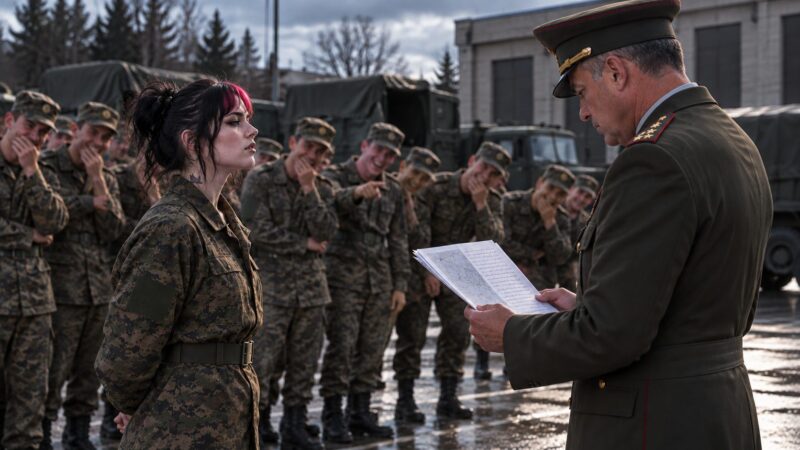
Then, one morning, the commander suddenly ordered the entire unit to assemble.
The soldiers lined up.
The commander stepped forward holding a folder.
His expression was noticeably more serious than usual.
“We have an urgent situation,” he announced.
“We’ve received a document written in Arabic. We need an accurate translation today.”
He paused.
“This document cannot be sent to civilian specialists. It cannot be photographed, and it cannot be uploaded anywhere online.”
The commander looked down the line.
“So I’m asking only once. Does anyone here actually speak Arabic well enough to translate it?”
For several seconds, nobody said a word.
The commander scanned the formation.
“No one?”
The soldiers exchanged glances.
One after another, they shook their heads.
Then a calm female voice came from the very end of the line.
“I do.”
Everyone turned at once.
Lulu stepped forward.
For a moment, nobody said anything.
Then someone quietly snorted.
A few seconds later, several soldiers were laughing.
“You’re serious?”
“She barely talks to us in our own language, and now she claims she knows Arabic?”
“Maybe she’s heard two Arabic songs and thinks that counts.”
One soldier laughed loudly.
“Commander, don’t give the document to that alternative girl. How do we even know she’s trustworthy?”
The soldiers laughed again.
Lulu simply looked at the commander.
Then she did something nobody expected.
“May I see the document?”
The commander studied her face for several seconds.
Then he opened the folder and handed her several pages.
Everyone expected her to become confused.
Instead, something completely different happened.
Lulu looked at the first page.
Almost immediately, she began reading the Arabic text aloud.
Her pronunciation was calm and confident.
There was no hesitation.
She spoke as naturally as if Arabic were her first language.
The laughter slowly disappeared.
The soldiers stopped smiling.
Lulu picked up a pencil and began translating the document line by line.
Every so often, she paused to explain that certain Arabic expressions in the document were being used in a specialized context and didn’t carry their usual everyday meaning.
Only a few minutes passed before the commander’s expression suddenly changed.
He reached into the folder and pulled out another sheet.
“Read this paragraph again.”
Lulu did.
The commander went pale.
The preliminary translation that had accompanied the document contained a serious error.
One sentence had been translated so incorrectly that its meaning was almost the complete opposite of the original.
If Lulu hadn’t caught it, the command could have completely misunderstood the message.
Nobody was laughing anymore.
The commander slowly looked at the young woman.
“Where did you learn Arabic like that?”
Lulu remained silent for a moment.
Then she answered quietly.
“My father was a translator for many years.”
She looked down at the papers.
“When I was little, he made me study with him every day. At the time, I hated those lessons.”
She paused.
“Then he died.”
The room became quiet.
“I continued studying the language on my own.”
The commander closed the folder.
“From now on, every Arabic document comes through her first.”
The soldiers looked at one another.
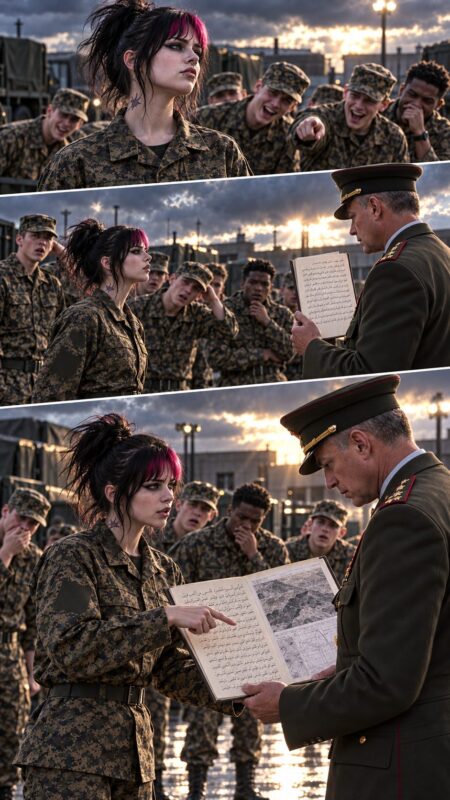
One of the men who had mocked her earlier gave an awkward smile.
“Listen… we were only joking.”
Lulu looked at him.
For the first time since she had arrived at the unit, she smiled.
“It’s all right.”
The soldier looked relieved.
Then she added,
“I made an incorrect assumption too.”
He frowned.
“What assumption?”
Lulu adjusted her sleeve, covering part of the tattoo on her arm.
“I thought that in the army, people were judged by what they could do first…”
She looked around at the soldiers.
“…and only afterward by how they looked.”
Nobody laughed.
Nobody had an answer.
The same people who had spent days judging Lulu by her hair, tattoos, piercings, and silence were now standing quietly in front of someone whose ability had just solved a problem they couldn’t.
And from that moment on, nobody in the unit looked at the “alternative girl” quite the same way again.