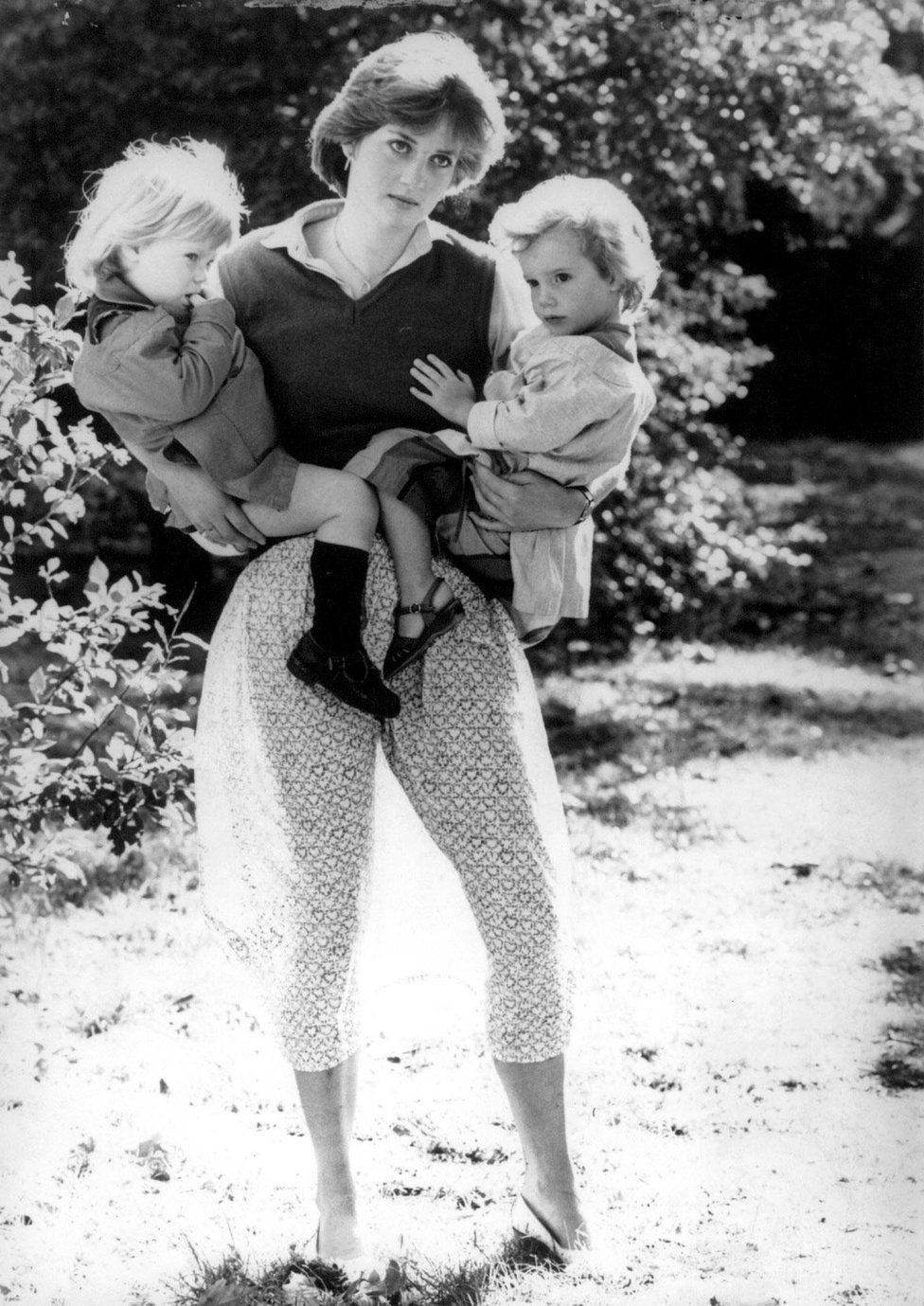
There are stories of Princess Diana that linger in memory not because of the grandeur of palaces or the shimmer of jewels, but because of their simplicity. They are the stories of a young mother kneeling in the grass to tie a shoelace, laughing with her boys on a carousel, or carrying a child on her back while others looked on. These moments, humble though they may be, captured the heart of the world.
One such story unfolded in 1993, at an amusement park where Diana had taken William and Harry for a day of ordinary fun. Accompanied by her bodyguard, Ken Wharfe, and his son, Diana blended into the crowd, queueing like any other parent, refusing the privilege of cutting lines or closing down rides. She was not a princess that day — she was simply “Mum.”
The Day at the Amusement Park
Those who were there remember it vividly. The teacup carousel spun with laughter as Diana, hair windswept, joined her sons in their joy. Later, they ventured into the river, their clothes and hair soaked through. Most mothers might have worried about appearances; Diana only beamed, her smile bright enough to warm everyone around her.
By the end of the day, exhaustion had set in. Ken Wharfe’s young son could hardly walk. But the bodyguards could not take him into their arms — their duty was to keep Diana safe, eyes constantly scanning the crowd, hands free for emergencies. And so it was Diana herself, the Princess of Wales, who stooped down and carried the boy on her back, William and Harry trotting alongside her.
It was an image that captured her essence: a princess not above lifting the burdens of others, literally and figuratively.

A Life of Compassion
That moment was not an exception but a reflection of who Diana was. Her compassion was not calculated for cameras, nor reserved for her own family. She carried the children of strangers, held the hands of the sick, and embraced those society often shunned.
Her visits to hospitals and shelters were legendary. She walked into wards of leprosy patients without hesitation, sitting at their bedsides, shaking hands that others recoiled from. She championed the homeless, spending time in shelters, listening rather than lecturing. To many, she was the “People’s Princess” not because of her crown, but because of her humanity.
And yet, she endured immense personal suffering. While she gave her heart to the public, her marriage to Charles was crumbling under the shadow of Camilla Parker Bowles. Diana’s pain was etched across her face in televised interviews, yet even then, her instinct was not bitterness but care for her sons and compassion for those less fortunate.
The Coldness of Camilla
In stark contrast, Camilla’s reputation has long been clouded by stories of indifference. Where Diana bent down to meet a child’s gaze, Camilla often seems to recoil. On one occasion, when a young girl ran toward her seeking a hug, Camilla offered only the briefest pat on the back, her eyes already elsewhere. In another instance, she tugged at a child’s bracelet to avoid direct contact with the child’s skin — a gesture that, to many, symbolized her discomfort with warmth.
To her critics, Camilla embodies distance rather than embrace, calculation rather than instinct. She is described as the “nightmare of children,” not because of malice, but because of the absence of that natural tenderness Diana possessed in abundance.
Two Legacies, One Crown
The contrast between Diana and Camilla is not merely a matter of personality — it is a matter of legacy. Diana’s memory still burns bright in the hearts of millions, especially those who grew up seeing her kneel beside the vulnerable, smile through her pain, and reach out to strangers as if they were family.
Camilla, now Queen Consort, has never truly escaped that comparison. No matter how many public duties she performs, how many banquets she attends, or how many titles she bears, she cannot erase the image of Diana carrying children on her back, soaked with river water, laughing as if joy itself were a crown.
Do We Hate, or Do We Remember?
The question often asked is blunt: Do you hate Camilla? But perhaps the more important question is different: Why do we still love Diana?
Hatred fades; love endures. Diana’s memory lives on not because she was perfect, but because she was human in the truest sense of the word. She showed the world that royalty need not mean detachment, that crowns can sit lightly on heads that bow down to embrace the smallest and weakest.
Camilla’s coolness may leave her judged harshly, but Diana’s warmth ensures she is remembered tenderly. In the end, that is the greater power.
A Mother’s Example
For William and Harry, that day in 1993 was not about teacups or rivers or even bodyguards. It was about a mother’s willingness to carry the tired child of another, to put aside her title for the sake of kindness.
And for the world, it was a glimpse of the monarchy as it might be: not aloof, not untouchable, but deeply, profoundly human.
Diana’s arms may no longer carry children, but her example still carries hearts. And no matter how history judges Camilla, Diana’s legacy is secure. She remains, forever, the mother who carried not just her sons, but a world hungry for compassion.