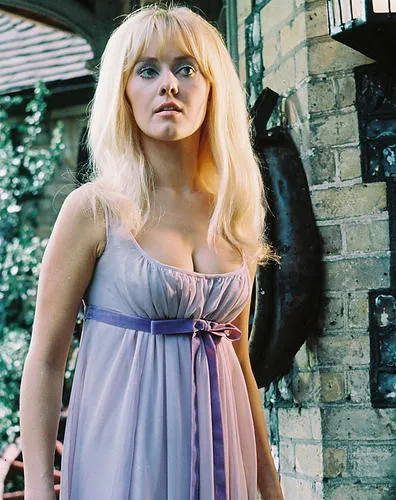
In 1971, Hammer Films released Lust for a Vampire, a gothic horror tale that would prove to be both a product of its time and a curiosity for the decades that followed. By then, Hammer had built a reputation as the studio of blood-red capes, candlelit castles, and unforgettable vampires, but audiences were beginning to change. The late 1960s had brought a wave of freer, more daring cinema, and Hammer responded with the Karnstein Trilogy, a series loosely inspired by Sheridan Le Fanu’s
Carmilla. At the center of the trilogy’s second film was a young Danish actress named Yutte Stensgaard, whose performance remains one of the film’s lasting legacies.

Born in 1946 in Denmark, Stensgaard moved to London in her early twenties, seeking a career in entertainment. She began modestly, appearing in television shows and small film roles, while also working as a model. With her striking blonde looks and natural screen presence, she quickly caught the attention of casting directors. Hammer, known for discovering and spotlighting actresses who could blend allure with danger, offered her the role of Mircalla Karnstein, a vampire resurrected to haunt the halls of a secluded finishing school.

Lust for a Vampire was envisioned as a sequel to The Vampire Lovers (1970), which had already startled audiences with its unapologetic mixture of gothic atmosphere and overt sensuality. Hammer’s gamble was clear: in order to compete with a changing industry, they leaned into themes of eroticism while still wrapping their stories in the trappings of fog-shrouded castles and aristocratic decadence. Stensgaard stepped into this world with both freshness and confidence.
The story unfolds in a finishing school for young women, located in a grand castle surrounded by shadow and silence. Mircalla is resurrected from the grave in a ritual sequence — one of Hammer’s most memorable moments of gothic theater — and introduced under a false identity to the unsuspecting teachers and students. There she mingles, charms, and seduces, all the while concealing her predatory nature. Her beauty is disarming, her innocence convincing, yet behind her gaze lies the hunger of a vampire. It is this duality that made Stensgaard’s performance so striking. She played Mircalla not as a one-dimensional monster, but as a tragic figure suspended between desire and doom.

The film complicates its gothic horror with a romance subplot. Ralph Bates plays novelist Richard LeStrange, who arrives at the school with literary ambitions but soon finds himself enthralled by Mircalla. His obsession blurs the line between dream and nightmare, as the audience watches him spiral deeper into danger. Their relationship embodies one of Hammer’s favorite motifs: the fatal attraction, where love and death become inseparable.
Behind the scenes, however, the film was troubled. Veteran Hammer director Terence Fisher was originally set to helm the project, but an accident forced him to withdraw, leaving Jimmy Sangster to step in. Budgetary constraints and shifting creative decisions gave the production an uneven tone. At times it reached heights of gothic beauty; at others, it veered into camp. The inclusion of a contemporary ballad, “Strange Love,” performed during a romantic sequence, has long divided viewers. For some, it undercuts the horror; for others, it adds to the surreal, dreamlike quality that makes the film unforgettable.

Despite these flaws, Stensgaard emerged as its centerpiece. Her Mircalla was both angelic and sinister, a figure who captured the contradictions of Hammer horror in the 1970s. Unlike Ingrid Pitt’s ferocious Carmilla in
The Vampire Lovers, Stensgaard offered a softer menace. Her vulnerability made her character’s violence all the more jarring, while her screen presence lingered long after the final scene.
Lust for a Vampire was the highlight of a short-lived career. She appeared in a handful of other films and television shows but gradually drifted away from acting in the mid-1970s. By the end of the decade, she had left the industry altogether, moving on to other pursuits. Her absence from the screen only added to her mystique, turning her into something of a cult figure among Hammer aficionados. Fans of the studio often regard her as a hidden gem, a performer who embodied the strange, intoxicating blend of glamour and horror that Hammer specialized in.

Over time, Lust for a Vampire developed a cult following. Critics at the time were often dismissive, calling it campy or melodramatic, but reappraisal has been kinder. Modern audiences view it as an artifact of transition, caught between the classic gothic horrors of the 1950s and ’60s and the looser, more experimental horror films that would dominate the 1970s. Its lush castle settings, velvet-draped interiors, and candlelit rituals create an atmosphere that remains uniquely Hammer. For horror enthusiasts, it represents the moment when gothic cinema flirted openly with sensuality, pushing boundaries that were previously only hinted at.
Yutte Stensgaard’s portrayal of Mircalla Karnstein has become central to the film’s enduring reputation. She embodies the allure of the vampire myth itself: beautiful, dangerous, and unforgettable. In her hands, Mircalla is not just a monster but a symbol of desire and fear entwined, a character who lingers in memory like a half-remembered dream.
So who was Yutte Stensgaard, really? To most audiences, she remains a mystery: a Danish actress who lit up the screen for a brief moment before vanishing into private life. To Hammer fans, she is a legend, forever immortalized in the role of the vampire who haunts a finishing school and turns love into death.
Lust for a Vampire may not have been a critical triumph, but it endures because of her. Behind velvet curtains and within the shadowed castle halls, Stensgaard gave a performance that still sparks fascination more than fifty years later.

What really happened at the castle? The film leaves that answer veiled in secrecy, drenched in atmosphere, and punctuated by blood and desire. What remains clear is that Yutte Stensgaard’s Mircalla has outlasted the film’s flaws, securing her a place in horror history. Sometimes legends are born not from perfection but from presence — and hers, even in a single defining role, continues to cast a spell.