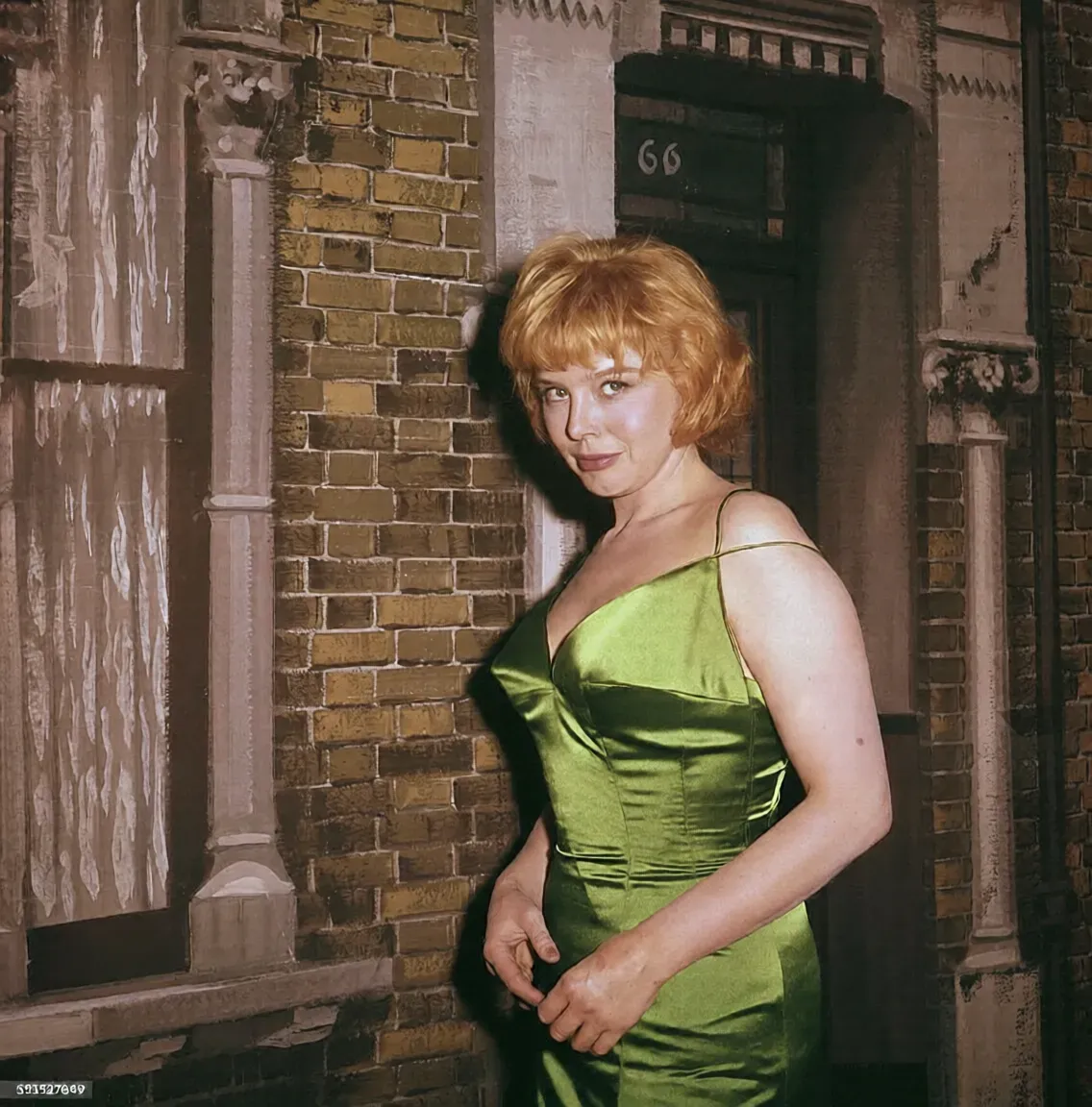
She entered the world as Janet Neilson Horsburgh on September 28, 1934, in the seaside town of Blackpool, England. Performing was practically in her blood; her father, Alex Munro, was a respected Scottish comedian, and his life on the stage enveloped her from childhood.
Janet spent her formative years wandering backstage corridors, breathing in the smell of makeup powder and stage curtains, and watching entertainers prepare for their fleeting minutes under the spotlights.
For her, imagining a life outside of performance felt almost impossible. Becoming an actress didn’t simply appeal to her—it felt like following a path carved out long before she understood it.
Her first steps into the entertainment world began in the early 1950s, when she appeared in television programs and live broadcasts. Almost immediately she attracted attention.
Directors and producers were drawn to her expressive face, the warmth in her presence, and the instinctive vulnerability she brought to even the smallest roles.
It became clear she had something rare: a freshness that audiences loved, combined with a dramatic depth that made her stand out from other young actresses of the time. By the end of the decade, her life took a decisive turn.
Walt Disney, who was actively looking for emerging British talent, saw in Janet exactly what he wanted: sincerity, charm, and a natural connection with viewers. She soon became one of the studio’s most promising discoveries.
Her breakthrough arrived in 1959 with the fantasy adventure Darby O’Gill and the Little People, in which she starred opposite a then little-known Sean Connery. The film became a beloved classic, and Janet’s heartfelt performance earned her the Golden Globe Award for Most Promising Newcomer.
Practically overnight, she became a familiar face, celebrated in advertisements and studio promotions, adored by moviegoers captivated by her blend of innocence and inner strength.

Her success continued with Swiss Family Robinson
in 1960, another Disney production that increased her visibility and reinforced her wholesome image. Hollywood greeted her with open arms, and the studio hoped she would remain one of their signature actresses for years to come.
Yet behind the curtain, the experience was far more complicated for her. The pressure to maintain a spotless, family-friendly image felt restrictive.
She found the Disney mold tightening around her, shaping her persona in ways that didn’t reflect her true self. The studio cherished the word “wholesome,” but Janet felt confined by it.
Seeking roles that challenged her more deeply, she deliberately moved toward dramatic, adult-oriented films. Her instincts proved right. In Life for Ruth (1962), she delivered a nuanced and powerful performance that demonstrated her emotional capability.

She continued exploring darker, more complex territory in Bitter Harvest (1963), portraying a troubled young woman drifting through disappointment and instability. Many later observers noted that the role seemed uncomfortably close to the personal struggles Janet would soon face off-screen.
During this same period, her private life grew increasingly complicated. She married actor Tony Wright in 1957, though the relationship dissolved within a few years.
In 1963, she married actor Ian Hendry, a gifted but deeply troubled man. His battles with alcoholism and emotional volatility created an intense and often painful home life, even as the couple welcomed two daughters, including Sally Hendry, who would later become an actress.
Janet, already dealing with her own internal conflicts, found herself overwhelmed by anxiety, depression, and eventually a growing dependence on alcohol.

These difficulties inevitably affected her career. By the mid-1960s, the momentum she had enjoyed began to slow. She still worked, appearing in television programs and the occasional film, but the glamour of her earlier years had faded.
Industry insiders whispered doubts about her reliability, while those who knew her more intimately insisted she was simply worn down—emotionally exhausted by years of pressure, disappointment, and personal turmoil.
Even so, her natural gift never disappeared. Viewers who saw her later performances often remarked on the haunting quality she brought to them, as though she carried within her all the intensity of a life lived too fast and endured too painfully.
Janet held onto hope, determined to rebuild her career and reclaim a sense of stability. Yet her body, weakened by stress and years of emotional strain, could no longer endure what her spirit tried to push through.

On December 6, 1972, she collapsed and died at just 38 years old, the result of a heart condition compounded by chronic stress and alcohol misuse. The news stunned those who had worked with her and devastated fans who remembered her as the luminous young woman from Disney’s golden age.
To many, she remained frozen in time, forever youthful, eternally radiant.
Her funeral was quiet, intimate, and heartbreakingly small. Those closest to her described her as deeply warm, fiercely emotional, and extraordinarily fragile beneath the surface.
She left behind two children, a brief but memorable film legacy, and an unforgettable impression on audiences who had fallen in love with her sincerity. Even though her time in the spotlight was short, Janet Munro’s influence lingers.

Film historians often speak of her as one of Britain’s most promising talents of her generation, an actress capable of blending gentleness with intensity in a way few could match. Disney enthusiasts continue to celebrate her early work, and classic-film lovers revisit her performances with a mix of admiration and sadness.
Her life remains a poignant reminder of the cost of fame and the vulnerability that can hide behind a glowing screen presence.
Her story endures not only as a Hollywood tale, but as the portrait of a young woman pulled between expectation and truth, success and suffering, hope and heartache.
She gave audiences magic while carrying storms no one could see, and though she left the world far too soon, the light she created has never truly faded.