The humidity in Savannah was thick enough to chew, a heavy, floral-scented blanket that settled over the two hundred guests packed into the Cathedral of St. John the Baptist. It was the kind of heat that made silk stick to skin and made the heavy scent of lilies feel almost suffocating. At the front of the aisle, standing under the vaulted ceilings and the watchful eyes of a dozen stone saints, Arthur Pendergast felt the sweat trickling down the back of his neck.
Arthur was a man of spreadsheets and soft-spoken certainties. He had planned this day for eighteen months. Every peony was positioned according to a color gradient; every seating card was hand-calligraphed. He looked down at his polished oxfords, then up at the massive oak doors at the back of the church. Any second now, those doors would swing open, and Clara Clark would walk toward him.
Then, the organ music shifted—a triumphant, soaring chord that signaled the start of the processional. The heavy doors groaned open.
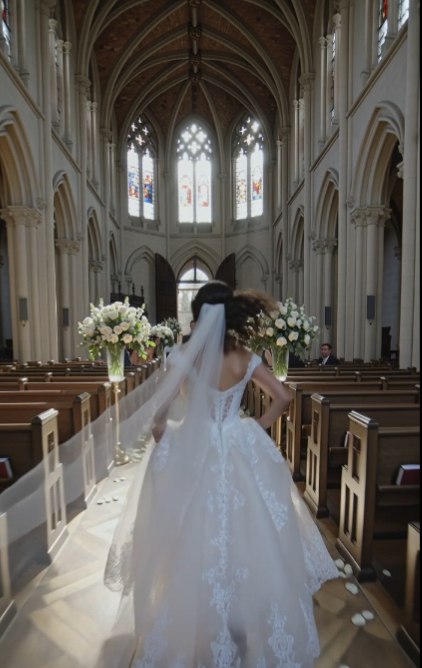
Clara appeared, framed by the blinding afternoon sun. She looked like a vision from a pre-Raphaelite painting, her ivory lace gown cascading around her in intricate waves, her veil a sheer cloud that seemed to catch every stray photon of light. But as she took her first step, she didn’t look at the flowers. She didn’t look at the guests. She looked at Arthur.
And in that moment, the “certainty” Arthur had built his life upon began to crumble. Clara’s face wasn’t glowing with the soft radiance of a bride; it was pale, her eyes darting like a trapped bird’s. She took three measured steps, her breath coming in ragged, audible hitches that reached the front row.
“Arthur,” she whispered, though the word was lost to the cavernous room.
She stopped. The organist, sensing a hitch in the program, held a suspended chord that hung in the air like a question mark. The silence that followed was deafening. Clara’s hand went to the throat of her dress, her fingers tangling in the delicate lace. She looked at the exit behind her, then back at the altar, where a life of spreadsheets and quiet tea parties awaited her.
Suddenly, she didn’t just move; she ignited.
Clara spun on her silk-covered heels. With a gathered fistful of tulle and lace, she didn’t walk—she bolted. Her white heels clicked rhythmically against the marble floor, a frantic staccato that echoed off the stained glass. The long, embroidered veil caught the air, billowing out behind her like the wings of a moth escaping a flame.
“Clara!” her mother shrieked from the front pew, but the bride was already halfway to the door.
Arthur watched her go. He watched the way her shoulders stayed set with a sudden, fierce determination. He watched the light catch the sequins on her bodice one last time before she reached the threshold. The realization hit him with the force of a physical blow: she wasn’t coming back. The spreadsheet of his life had just been deleted.
The world began to tilt. The vibrant reds and blues of the stained-glass windows swirled together into a muddy violet. The smell of the lilies became an overwhelming wave of funeral incense. Arthur felt the blood drain from his face, leaving him cold despite the Georgia heat.
“Arthur? Son?” the officiant reached out a hand, but it was too late.
Arthur’s knees turned to water. His eyes rolled back, catching one last glimpse of the vaulted ceiling before his vision went black. He crumpled backward, his black tuxedo ruffling as he went down. He didn’t hit the floor, though; the officiant and the best man lunged forward, catching him in a tangle of limbs and frantic whispers just as the heavy oak doors slammed shut behind the fleeing bride.
Outside, the bells began to chime—not for a wedding, but for a getaway.